

Fred Perdue Senior
More often than not, we think of our fathers as our dads, but the truth is if we have not been subjected to a DNA check, we don’t really know who our father is. DNA stands for Deoxyribonucleic Acid. It is a molecule that carries the genetic instructions essential for the growth, development, functioning, and reproduction of all living organisms. DNA is composed of two strands that coil around each other to from a structure known as a double helix, and it contains the information necessary for the transmission of inherited traits. We won’t get into a mother’s sexual habits here, but more than one child has asked, “who really is my father?” I had a friend in high school who looked nothing like his dad but nearly identical to his uncle. Could have his mother, would his mother have, possibly, he went to his grave never knowing.
The purpose of this document is to tell what I know about my dad whom I believe was my father. His name was Fred Perdue without a middle name or initial. He was born April 4. 1908 to Mary Perdue born March 16, 1874 and Edward G. Perdue. born October 1. 1872. Mary was murdered in 1918 when Fred was ten years old and Edward died on June 10, 1946 of Amyotrophic Lateral Sclerosis (ALS) better known as Lou Gehrig diseases.
Dad’s grandfather was Daniel Green Perdue who was born June 10, 1830 in Sumner County Tennessee and died October 9, 1915 in Strasburg, Missouri. Daniel G. Perdue came to Marshall County Kansas around 1859 and homesteaded west of Waterville, Kansas on the western banks of Coon Crick. A photo of his homestead is provided above.
Dad’s father, Edward, is believed to have been born in the house shown in the photo. The evidence of the farm’s existence has disappeared over the years and at last check was a field of wheat.
When each of Daniel’s children reached the age of twenty-one the story is he gave them each one thousand dollars in gold. Edward, Fred’s father, is believed to have used that gold 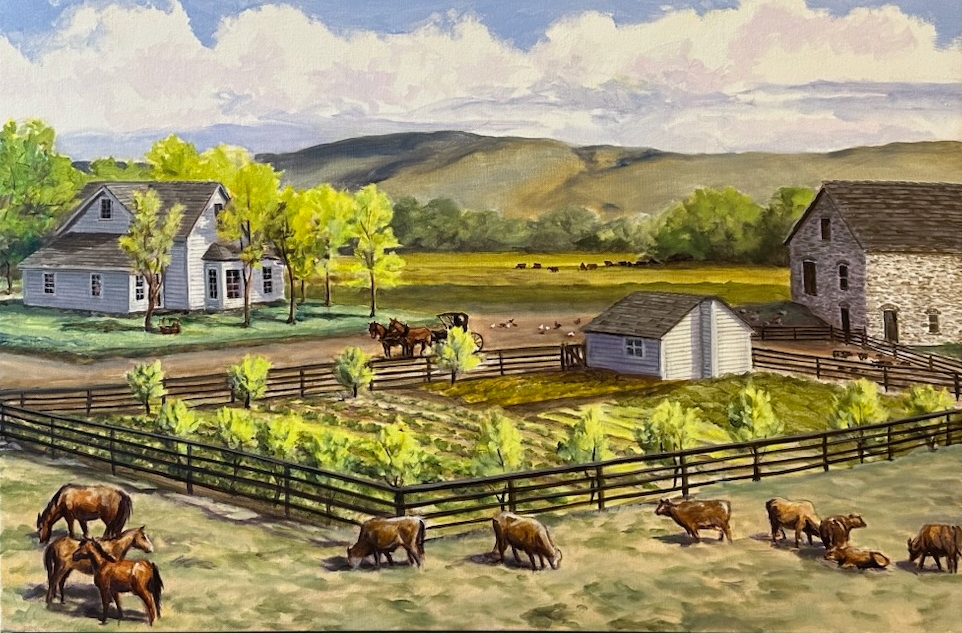 to purchase eighty plus acres immediately across Coon Crick from where he was born, the parcels eastern boundary bordering on the town of Waterville, Kansas.
If a person is interested in locating the parcel it is the land north of W. Main Street west of Highway 77 running all the way to the bridge that crosses Coon Crick. It is on this parcel that my father, Fred Perdue, was born.
Fred was the youngest son of Mary and Edward’s seven sons. Three daughters came after Fred’s birth in 1908. Legend has it that Mary was poisoned by a local doctor immediately after birth of the third daughter and subsequently died in March 1918. The story is that a German doctor provided Mary an ointment to use laced with some bacteria similar to anthrax. The story is that two of dad’s brothers engaged the doctor as he left his office one night and beat him to a point that they thought he was dead. However, he survived and moved to Fort Riley, Kansas where he worked with the calvary’s saddles. He was said to have been convicted of rubbing a substance into saddles that caused the death of riders and was tried, convicted and executed.
When Mary died Edward sent the three young girls to a neighbor to be raised in Waterville, Kansas. The boys, of which five were alive, moved with Edward to a farm he either owned or leased. The boys grew up to be constantly fighting and terrorizing the community. For example, Fred’s brother Dan took the paddle from the teacher when she tried to spank him and pulled up her skirt and paddled her instead. The boys participated in all sports of which boxing or fighting was the most popular.
Dad often spoke of he and his four living brothers living out on the farm they owned or leased and the work that my grandfather and they had to do. Dad said when there was no work on the farm his dad would farm the boys out to work for other farmers. Dad was never one to complain about working. He had worked daylight to dark seven days a week from age ten and believed it to be a normal thing to do. I never ever saw him take time off for illness though he was sometimes ill. He would say, “The best way to cure illness is to work it out of your system.” It was not an idle philosophy with him; he practiced what he preached and expected us kids to do the same. I have worked since the age of nine and one of many joys I have in life is liking work. However, Dad took it to an extreme.
When I was born, I had strabismus, a gene taken from my mother. The family did not have the means to have it surgically corrected so I lived until I could afford the surgery. At age nineteen while attending Yakima Valley Community College I sold my car and talked a local ophthalmologist into surgically straightening my eyes. If the procedure had been done prior to the age of six it would have also improved my vision but at age nineteen that was not possible.
When doctor Thompson came to my hospital room the morning after the surgery, I asked if I could go home. He chuckled and said, “My boy you will probably be here for a week.” The thought of not being able to work and earn money for a week was a shock and I told him, “Doctor, I cannot afford to be in this place, I have no money.” “Well,”, he said, “If you insist I will release you this morning, but I want you to stay inside out of the wind and dust and make sure you keep that eye bandage clean. My suggestion is you do that for at least a week.”
I arrived home at lunch time still feeling pain ready to go back to bed. Dad seeing me come through the door said, “Damn, am I glad to see you, we’re chopping alfalfa in the field and need another hand.” I did not even relate what the doctor had said to him for I knew his position. I spent that afternoon and a few days after enduring more pain than I thought was possible and doing my best to keep the wound clean.
That old man gave me a great gift in learning to accept and enjoy working. Years later as others vacationed, I worked. My Dad taught me to enjoy work and I do, beyond recreation enjoyment.
Fred grew rapidly and by his teenage years reached his maximum height of six foot two inches and two hundred and thirty pounds. He was known throughout the community for his weight lifting, playing catcher on the town team and especially his skills in boxing. He boxed with his brothers nearly every day. At age thirteen, following completing his last year of eight years of formal education, he ran away to Rogers, Arkansas where an older brother lived. The photo to the right shows Dad at age 13. There he lied about his age and obtained a license to become a prize fighter boxer.
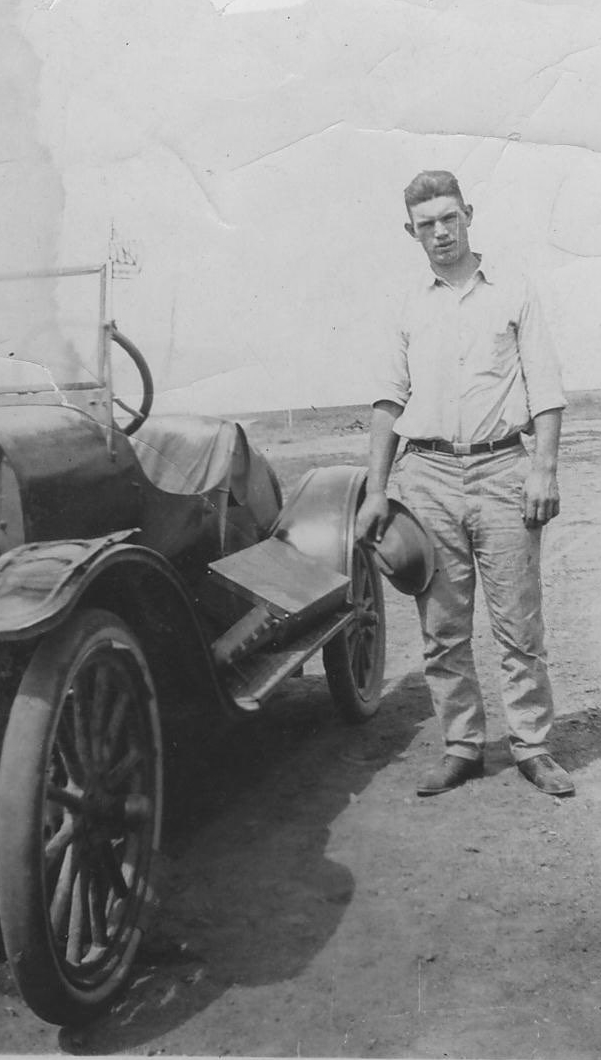 All through the 1920s he would travel to towns in the Midwest. Mostly he worked as a logger becoming proficient in spotting walnut trees as he rode along on trains and in cars. He often was accompanied by his cousin Pat Henderson a small wiry individual not half Fred’s size.
Boxing was popular in local circuses and often Dad and Pat would ride the rails into a town where a circus was being held and Pat would recall Fred saying, “Patrick, here is where we eat and would challenge the fighters the circuses put up. He didn’t win them all but most and as he was to say, “We ate!”
Dad never discussed his boxing exploits but many I met over the years were more than happy to talk about his prize fighting days for him. I leave it the readers of this article to prove the stories wrong.
It was said Dad fought 89 professional boxing matches although my mother would say he had ‘physical fights’ beyond her count. Some of the nonprofessional fighting I witnessed and will describe those later in this article. It was said in the 89 fights he was never knocked out and but once was knocked to one knee.
He fought on fight cards with people like Ezzard Charles, https://en.wikipedia.org/wiki/Ezzard_Charles in Chicago and Joe Louis, https://en.wikipedia.org/wiki/Joe_Louis in San Francisco. I was told he in fact boxed Jim Braddock, https://en.wikipedia.org/wiki/James_J._Braddock on three separate occasions, however I have found no documentation of any of this. I do know he and Joe Louis were friends for when Joe would come to Yakima refereeing wrestling matches long after retirement Joe would seek him out to visit. Dad did relate a time in San Francisco when Joe and he were bar hopping and Joe would only drink milk.
One of my dad’s many short comings was that he was an alcoholic and would often drink whiskey and smoke cigars between rounds. There is a story of Jack Dempsey’s manager, Jack Kearns, approached Dad at the end of one of his fights in Chicago and told him if he would straighten up and take fighting seriously, he would take him to New York where he would make some money. It is said dad’s reply was, “Why in hell would I go to New York, I don’t fight for money, I fight to eat and to have fun!”
Once when Dad was in the county jail in Marshall County, Kansas for the charge of bootlegging, he was asked if he would be featured as the local attraction in a boxing event to raise money for a new high school building in the area. The community had invited the Kansas State heavy weight champion from Topeka, Kansas to be his opponent. Dad agreed, and on the day of the outdoor match quite a crowd had gathered. Five deputy sheriffs escorted Dad through the crowd to the ring where his opponent had already arrived. Climbing into, the ring Dad’s brother, who was attending said to him, “God, Fred look at that guy! He is bigger than you and look at all of those muscles!!” To which dad’s reply was, “Hell, look at the guy’s eyes. He is scared as hell; he thinks I am about to eat him alive!” It was likely Dad’s escort that caused the fear, in any event Dad knocked the guy unconscious in a little over two minutes and it was a struggle to revive the guy, as it took over six minutes to revive him.
Dad had an African American friend named, Sundown, who was a sparring partner for Jack Dempsey. Sundown lived near the fairgrounds in Yakima and Dad often visited him and would be invited for a game of poker. I remember once when I was fourteen and batching alone with Dad, he came home all beat to hell from an outing at Sundown’s. He got me out of bed before daylight and we went back, as he would say, “To finish the job”. He took me, at age 14, to sit in the driver’s seat of the running car in the alley as he went back to “collect what had been stolen from him”.
I also remember picking up my car at a repair shop in Yakima once when in college and a stranger who was a mechanic there came up to me and asked if I was Dad’s son. He sat me down in a chair and began to talk about Dad’s career. Dad had obviously made an impression on him.
Before he and mother married, Dad and his brothers had developed reputations as “town terrors”. He was arrested numerous times for being “drunk and disorderly”. He spent a year in the Marshall County jail for bootlegging. He loved telling the story that he had to clean his cell with soap and water and mop it twice each week. To do so the Sheriff would allow him to go to the basement of the jail to get a bucket of soap and water and a mop. In the basement the Sheriff stored the bottles of alcohol confiscated from those they arrested and he would submerge a bottle in the bucket of soap and water and bring it to his cell and tuck it beneath the mattress he slept on. He was to say never during that year of confinement did he go without spirits.
He often told the story when dating the Sheriff’s daughter of him talking her father into letting him out to take her to the movies. I never knew the total of his legal exploits. I knew he was once jailed for knocking out a policeman with his hands and was jailed once for hitting a fellow with his fists wherein it took over six hours to bring the individual back to consciousness. Years later when I went to bury my uncle, I engaged a local attorney after being introduced by the local Catholic Priest. When the Priest introduced me to the attorney, he said, “So you’re Tiny’s boy, yes we all knew your dad!” Dad was called Tiny because he seemed larger than life to the local population and easily recognizable and was known by all the town’s people. One year after dad had passed, I was visiting my uncle in Marysville, Kansas and walking down the street, a man approached me saying, “I don’t know which one you are but I know you are a Perdue!’’ At the time I looked much like Dad only on a much smaller frame.
Dad never settled down but he did marry, not once but three times. Dad and mother met on an early morning on Broadway Street in the small Midwest town of Marysville, Kansas. Hannah, known to all as Lizzie, (shown below) was working as a night clerk in a small hotel boarding house and had stepped out onto the entry step for a breath of cool early morning air. Down the street from the tavern that had just closed for the night came Dad his jacket thrown over his shoulder and giving visible evidence of navigational problems.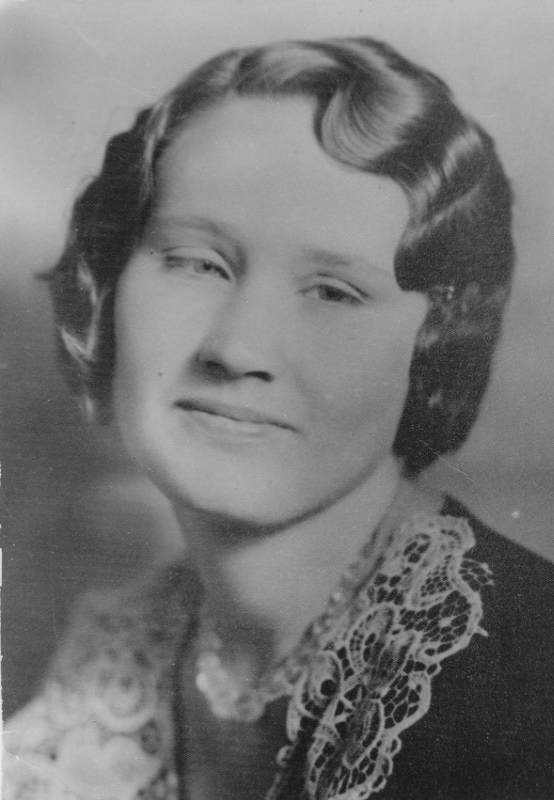 As Dad approached the entry area where Lizzie stood, he took the jacket from his shoulder and with some difficulty spread it on the walk near where she stood. Having the jacket appropriately spread, he staggered back from the Jacket a couple of paces and announced to all in ear shot, “I’m going to whip the first son-of-a-bitch that steps on that jacket!”
He was not likely to find anyone to accept his open invitation to fight that dark sultry night. However, he failed to reckon with the young girl minding her own business having a breath of the evening air. The temptation was too much; Lizzy jumped from the step, square in the middle of the jacket. The photo above is the best that I could find of my mother. It was taken about the time of marriage to Dad and she is believed to be 18 years old. From that first step to her last she would try to control the rough independent spirit that was Dad but in the end she would fail. He went to his grave believing he could whip any person he could get close enough to strike. He made believers out of many he knew and some who came too close.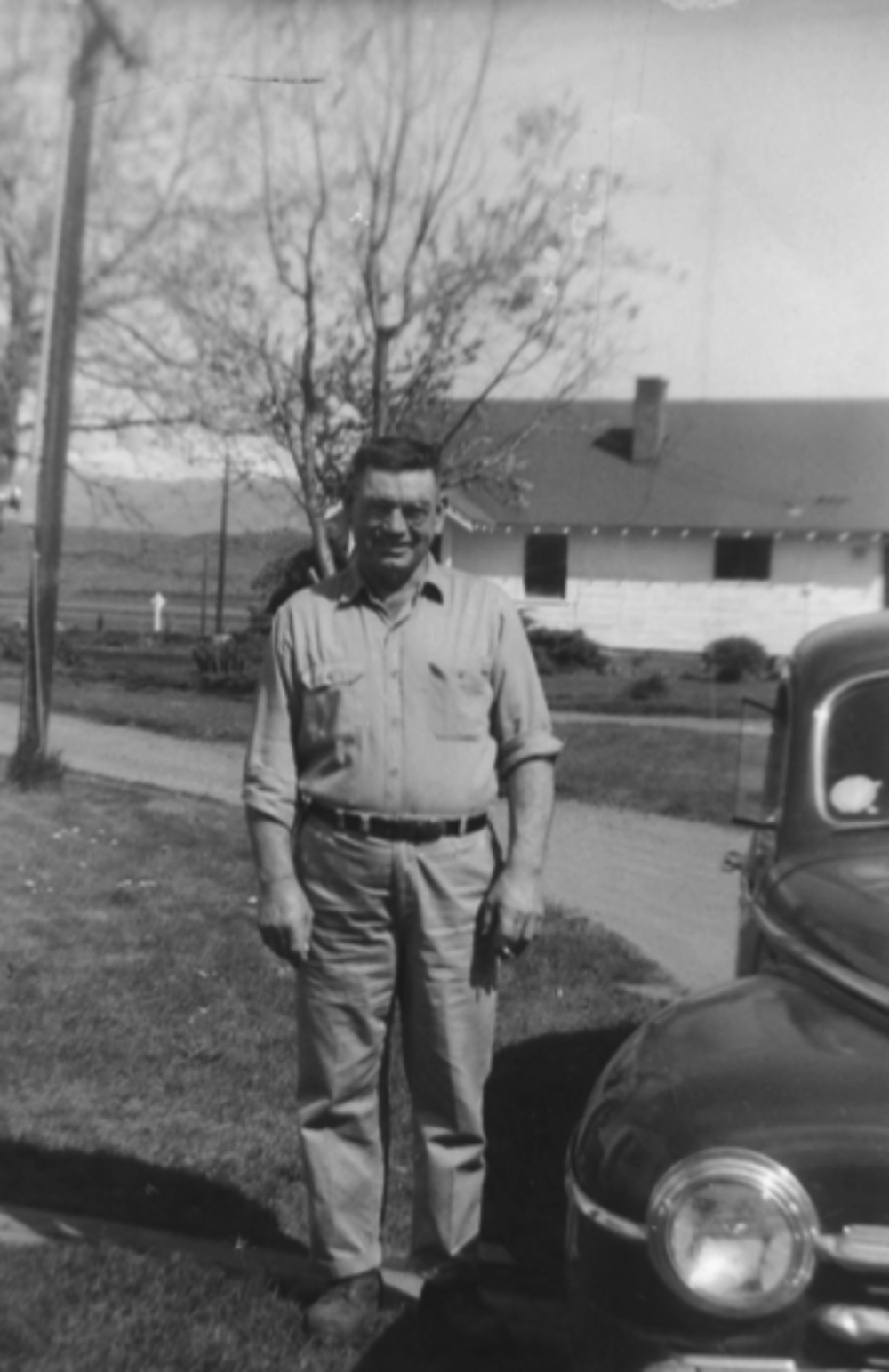 Over the years just prior to marrying Mom in the early 1930s, he had various jobs mostly in farming. He also became an expert in walnut timber assessment. It was logging and buying and selling walnut timber that would become his passion as he grew older.
Shown here is a photo of him at approximate age 50 while employed as a milker on the T. Benton Carey Diary Farm in Cowiche, Washington in the mid to late 1950s.
Six children, three girls and three boys of which four lived to adulthood were born to him. I was the third born.
When they first married Dad worked in logging in the Kansas area and adjacent states, but just before World War II the family moved to Salinas, California where Dad was employed as a ranch hand. It was there in 1939 that I was born. Shortly after my birth Dad was bitten by Black Widow spider in his left arm pit and he nearly lost the arm due to poisoning and infection.
The story he tells is one of working a lettuce field with a tractor and one day having a person stop his car near the field. A man, got out of the car who was dressed in a business suit and approached him. So, he stopped the tractor he was driving to speak with the man. The man said to him, “Are you Fred Perdue”, to which Dad is reported to have responded, “Yes, I am and what does it matter to you stranger?” “Well, he says, it matters more to you than to me. I am from the Federal Bureau of Investigation and we have noted that you have been ignoring your draft notices. Man, you have one of two choices, you either respond to the Draft Board or you go to prison for the duration of this war. I will await your decision as I rest in the car.” And the guy apparently walked away without uttering another word.
Dad did finally answer the draft notice and the government relocated him back to his home town and assigned him at private’s pay and all expenses to oversee logging operations of black walnut timber for the fabrication of gun stocks. Back he came to Marshall County Kansas with three children and a wife. He was provided new cars, new trucks, and logging equipment by the government and we hardly ever saw him until the war ended in 1945. He came home on occasion for I remember him bringing me a Collie puppy in his overcoat pocket when I was about three. I do remember that far back as I still remember getting my first pair of glasses at age three and a half.
After the war Dad continued to travel and buy and sell black walnut timber. And like most men that are away from their families for extended periods he found himself a girlfriend by the name of Maida Smith in Fall City. Kansas. My mother got wind of the relationship in March of 1947 and gave him the ultimatum, “I am taking the kids and going out west to Washington State where my brother and sister are. You are welcome to come along or stay with your girlfriend!” To that old man’s credit, he opted to keep the family together as he would one more time for Lizzie.
We arrived March 17, 1947 and Dad worked as a hired hand when we weren’t being fruit tramps traveling up and down the west coast picking fruit and living along the road in our car.
In 1950 he arranged with Benton Carey anytime access to the labor of Mom and us kids as well as himself for free lodging in a rat-infested house on Livingood Rd. in Cowiche, Washington. He worked the fields and orchards and part time at fruit warehouses and when out of work he would purchase wrecked automobiles and we would cut them up with coal chisels and sell the scrap metal.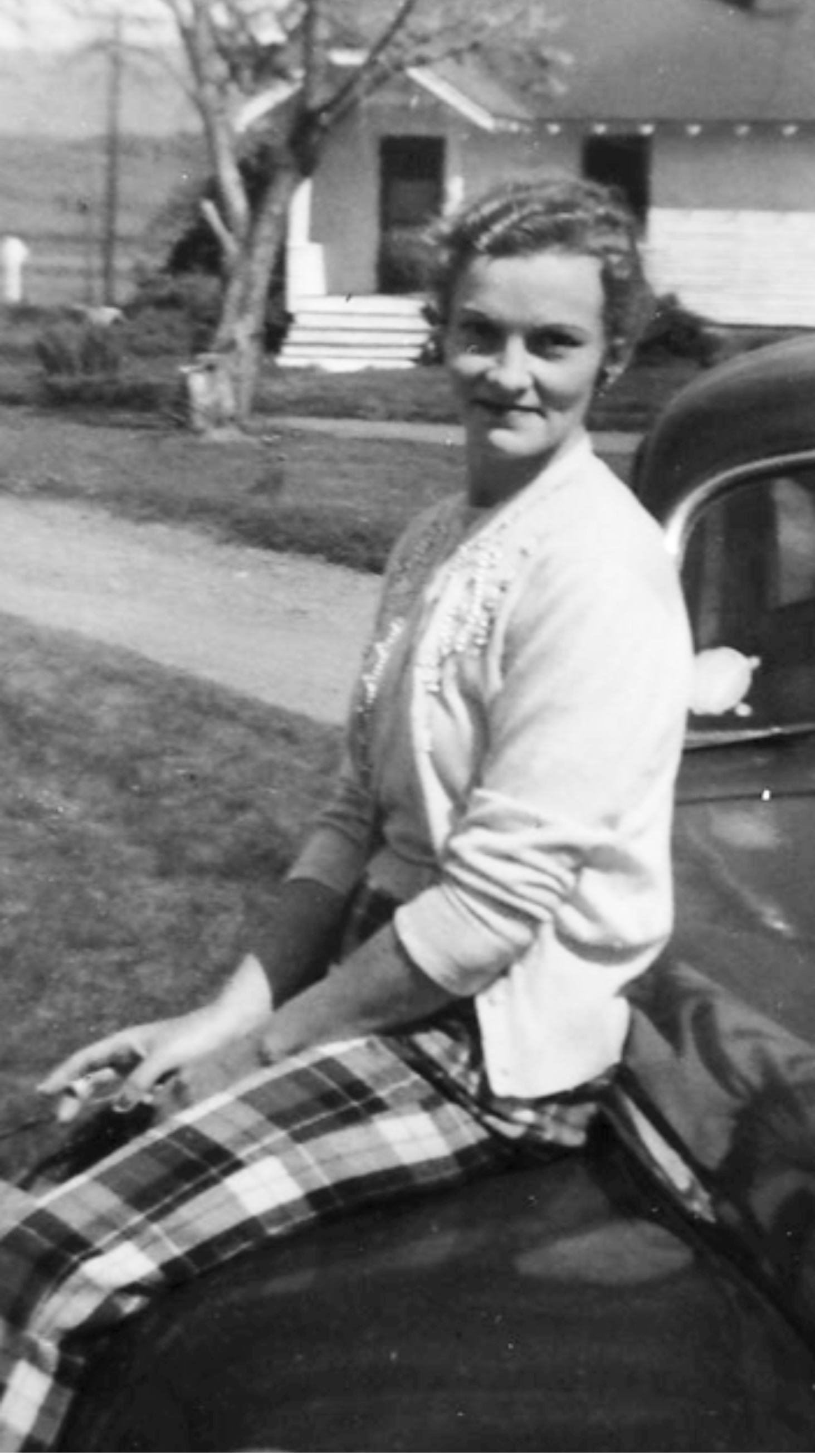 In the fall of 1951, my mother died. Dad had promised her on her death bed to see to it that all of her kids stayed together and all to get a high school education. An attempt was made by Mom’s family to farm each of us kids out to other families but Dad would have none of it. Within six month he had Maida Smith in the house and ultimately married her and then divorced.
He took a job as the ‘Milker’ on the Carey Dairy in about 1955 and remained in that job until approximately 1959. He met and married Phyllis Longmier (shown here), great granddaughter of James Longmier who brought the first wagon train through Cowiche in 1853.
Phyllis, like Dad, was an alcoholic. I had left the nest at the time she married Dad and had very little dealings with her.
In approximately 1960 Dad quit Benton Carey and went back to working various odd jobs and in May of 1961 he sent my younger sister to live with Phyllis’ aunt and he and Phyllis then returned to Marysville, Kansas and he resumed buying and selling black walnut timber.
There are many stories about the man but one I was a part of which reflect how quickly Dad’s personality could change from happy-go-lucky good humor to instant terror follows.
I had a classmate friend by the name DeWayne Wetmore and we often would chum around together. One Sunday morning my dad and I were sitting opposite the kitchen table each drinking a cup of coffee and having idle talk. He and I and my younger sister were living alone on the Carey Dairy Farm and my sister was away visiting friends for the weekend, so we were alone. It was a sunny calm day as we peered out the window over the kitchen table. The window gave a person a clear view of the driveway.
Sitting there that morning Dad drew my attention to a two-tone Nash Rambler coming down the driveway and commented, “I wonder who that is”, to which I replied, “I don’t know but it looks like Wetmore’s car,” The car was traveling too fast and when it stopped near our wooden plank walkway it threw gravel everywhere. We paid no attention though, and momentarily Ray Wetmore, DeWayne’s father came up the boardwalk, opened the screened door to the porch and walked through the open kitchen door to which Dad had his back as he sat enjoying his coffee.
Now Ray Wetmore was not a punny man, He stood nearly five feet eleven in height and weighed probably two hundred pounds. He worked in the fruit processing warehouses and was a volunteer fireman who believed in staying in shape. He entered the kitchen far enough that when he turned to face my dad he was about half way in the room. Neither, Dad nor I, had said a thing before Ray turned facing Dad and said, “Your kid stole my car jack!”
Dad was just finished sipping a drink of coffee and was in the process of returning the cup to the saucer. As soon as that cup touched the saucer, he was on his feet, and without a word, his right hand had all of Ray’s family jewels and his left-hand had Ray by the throat. Ray was screaming the best he could but was also was gasping for air and Dad had the man’s whole body suspended off the floor. I was sure Dad aimed to kill him and I know from dealing with Dad he sometimes preferred death over discussion. His motto being, “Never let someone beat you with their mouth!”
I was yelling for him to stop and he was yelling at me, “Stay out of this!” Dad, was trying to throw Ray out of the house; if the process killed him ‘so, be it’. As Dad walked Ray across the porch still flailing away and screaming, he found the screen door to the porch closed. Not having a third hand and too proud to ask me to open the screen door Dad threw Ray through the door tearing it off the bottom hinge.
Ray landed flat on his back on the boardwalk. I was still grabbing at Dad as he stepped out on a small concrete slab near the porch and said, “Now, you sonofabitch get up and knock and I will ask you to come in!” Ray was quiet now learning to breathe again but just laid there in shock eyes as large as goose eggs. Dad now directed his anger toward me telling me, “Get back in there and finish your coffee!” Which I promptly did. Dad joined me to resume drinking his coffee. No conversation between us.
Some sips of coffee and time went by and Ray finally gathered himself and walked up to the fractured screen door and knocked. Without turning the old man said, “Come on in, want a cup of coffee?” By that time Ray had entered the kitchen a second time but this time beyond Dad’s reach and said to Dad, “Your kid stole my car jack.” Dad looked at me and said, “Did you steal this man’s car jack?” I immediately responded, “No!” To which Ray says to my dad, “You going to believe him?” And dad looked up at Ray with that ‘you damned right’ look and said, “Man, do you think that kid would lie to ME!!”
Ray left but shortly after returned to say he had found the jack and to apologize. I lived my entire life worrying that my dad might kill someone and on occasion that someone might be me. He may have feared other human beings but if so, he never showed it.
I was at work in Fort Worth, Texas when my brother Fred called to report that Dad had died. After work I arranged a conference call with my brother and sisters, wherein it was decided I would go arrange the funeral and close out financial affairs and they would start for Kansas to attend the funeral. It was my decision to bury him in the family plot in Waterville, Kanas as opposed to burial in Yakima with my mom. I have always wondered what the two would have thought of that decision.
Dad, I found, had purchased a new Buick in 1962 which he was still paying for and owned a home in Oketa, Kansas on which his brother Ed held the note. I drove all night and arrived in Oketa about day break. I managed to clear the car and get it in Phyllis’ names and had her sign the house back to my uncle. I went to Topeka and arranged Social Security Support for my younger sister while she finished her schooling. Later I purchased a grave stone for Dad’s grave. After leaving to return to Fort Worth and work I never saw nor spoke to Phyllis again.
My dad and I were not friends but he was my dad and I owe those who survive me the telling of his story.
W. B. Perdue